
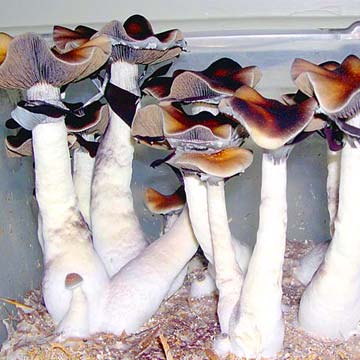
South Africa Transkei Spores
$ 8.95
Description Africa’s Contribution to Cubensis Research The Transkei region, now part of South Africa’s Eastern Cape province, is where this remarkable Psilocybe cubensis strain was first collected. Africa is significantly underrepresented in the catalogue of named cubensis varieties, making Transkei one of very few strains that can anchor the African data point in any global biogeographic study. The Eastern Cape features a subtropical to temperate climate along its coast, with adequate rainfall and cattle farming providing the substrate conditions cubensis requires. The strain was collected from dung in grassland areas and has been maintained in culture since. Spore Analysis Transkei spores are subellipsoid, 12 - 15 × 8 - 10 micrometers, with moderately thick walls and dark purplish-brown to black pigmentation. Prints are dense and richly colored. One feature that microscopists sometimes note is a slightly more variable spore shape compared to heavily cultivated strains, some spores in a given sample may trend toward broadly ellipsoid while others are more narrowly proportioned. This shape variation may reflect the strain’s relatively recent isolation from a wild population with greater genetic heterogeneity than long-cultivated lineages. Physical Profile Transkei fruiting bodies are medium-sized with caps that are convex to broadly convex, colored in warm brown tones with golden to orange hues that distinguish them from the cooler browns typical of many strains. Stipes are proportionally thick and firm, often slightly wider at the base. The bruising reaction produces intense blue-green coloration. The strain colonizes well at 25 - 28°C and fruits at 22 - 26°C. Its coastal subtropical origin means it handles modest temperature fluctuations better than purely tropical strains. Scientific Importance Transkei’s value to the research community extends beyond routine microscopy. As one of the only named African cubensis isolates, it provides essential comparative material for studies examining how Psilocybe cubensis has adapted to different continents. Comparing Transkei spore morphology and growth characteristics against Asian, American, and Oceanian strains offers a window into the species’ global radiation and local adaptation patterns. Sold for microscopy research, taxonomy, and educational purposes only. Please verify local regulations before placing an order.
Product Combinations/Sizes
| Polished Stainless Steel Frame |
Polished Brass Frame |
Frameless Polished Edge Mirror |
Beveled Frameless Polished Edge Mirror |
Overall Size W x H |
Shelves |
|---|---|---|---|---|---|
| CR1430-W | CR1430PB-W | CR1430PE-W | CR1430BV-W | 14″ X 30″ | 2 |
| CR1436-W | CR1436PB-W | CR1436PE-W | CR1436BV-W | 14″ X 36″ | 3 |
| CR1442-W | CR1442PB-W | CR1442PE-W | CR1442BV-W | 14″ X 42″ | 4 |